When Does a Workflow Become Autonomous?
A workflow becomes autonomous when software is given an outcome and held to it, not when it gains a model or loses its operator.
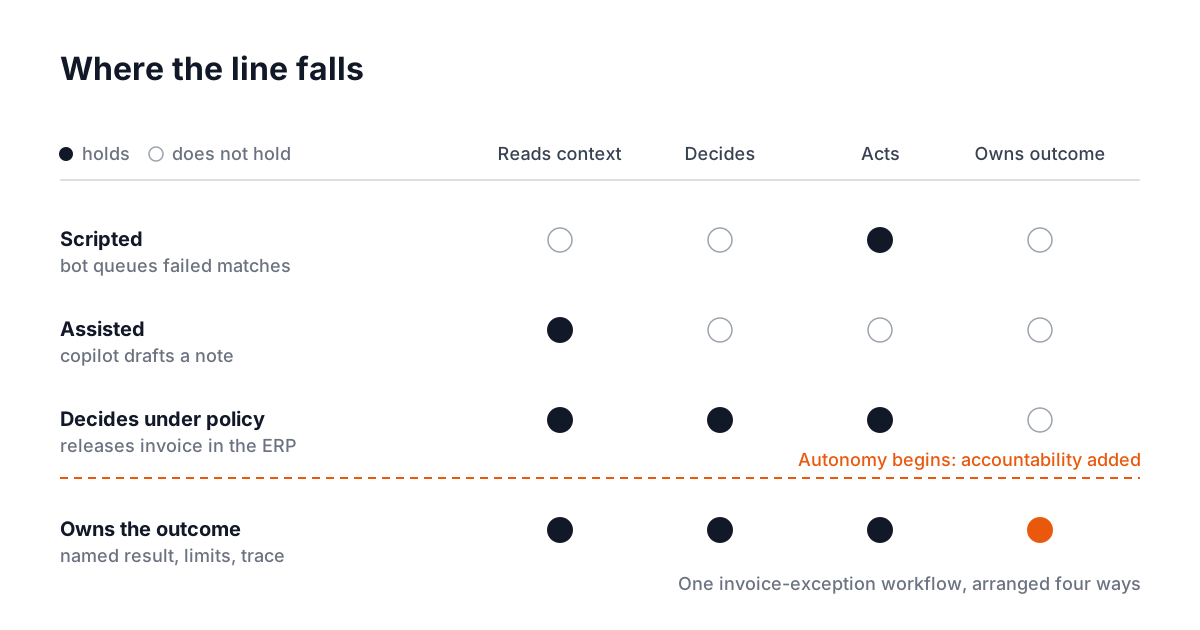
A workflow becomes autonomous at the point where software, rather than a person, carries the work to an outcome it is measured against, inside limits it cannot exceed, leaving a record from which its owner can show what happened. Adding a language model does not cross that line. Removing the person who used to press the button does not cross it either. What crosses it is whether, on the day something goes wrong, the organization can say what the software was supposed to achieve, what it was allowed to do, and on whose authority.
That claim is easier to test than to accept, so it helps to follow one workflow through the forms it commonly takes.
Four versions of the same workflow
Consider an accounts payable team that handles invoice exceptions: invoices that fail the match between purchase order, goods receipt and invoice. A quantity is short, a price differs from the contract, a receipt was never posted. Someone has to find out why and decide whether to pay, hold, or go back to the supplier.
The same work can be arranged in at least four ways.
- Scripted. A bot collects the failed matches each morning, copies them into a queue, and sends the supplier a templated notice. It acts, but every branch was written in advance, and it has no view of whether any exception was resolved.
- Assisted. A copilot reads the invoice, the order and the receipt, and drafts a note for the clerk: the receipt for line three appears to be missing. The clerk decides and acts. The software read context; it did not decide, and it wrote nothing back.
- Deciding under policy. The software reads the three documents and the supplier's contract, concludes that a price variance falls within tolerance, and releases the invoice for payment in the ERP. It reads, decides and acts. But the team is still measured on exceptions it clears by hand, and the software's work is visible only as postings under a service account.
- Owning the outcome. The software is assigned a named result, such as exceptions resolved within five working days with no payment released outside policy. Every release, hold and supplier query is recorded. Variances above its authority go to a person with the evidence attached. The team's measure becomes whether the software met its target and whether its escalations were sound.
Versions three and four look almost identical from a distance. They run the same model against the same documents and post to the same ERP. The difference between them is not visible in a demonstration, which is why it is so often missed.
The line is accountability, not capability
The site's definition names four properties that must all hold: context, decision, action and accountability. The first three are capabilities. A system either reads the systems of record or it does not. It either chooses among actions or follows a script. It either writes back or hands a recommendation to a person. Each of these can be shown in an afternoon.
Accountability is different in kind. It is not something the software does but an arrangement the organization makes around it: a named outcome with a measurable target, a written limit on what the software may do without approval, a path for handing cases to people, and a record detailed enough to reconstruct any case after the fact. Version three has the capabilities without the arrangement.
The gap shows up on a specific day. A released invoice turns out to be a duplicate of one paid last quarter. In version three there is no outcome owner to answer for it, no policy that said whether the release was permitted, and no trace beyond a posting log that records what changed but not why. The controller can see that the software paid twice. Nobody can say whether it was allowed to.
Accountability is not something the software does but an arrangement the organization makes around it.
This is why a capable system can still be unsafe to leave running. Its capability makes it fast. The missing arrangement means that when it is wrong, nobody can say how wrong, for how long, or under what authority. The capability and the arrangement are bought and built by different people, and only one of them shows up in a pilot.
Why the label slips
The word "autonomous" is applied far more widely than the arrangement exists. Gartner has described "agent washing," the rebranding of assistants and chatbots without significant agentic capabilities, as reported by Reuters in June 2025. In the press release behind that coverage, dated June 25, 2025, Gartner predicted that over 40% of agentic AI projects will be canceled by the end of 2027, due to escalating costs, unclear business value or inadequate risk controls.
Two of those three causes are accountability failures under other names. Unclear business value is what a project produces when no outcome was named at the start, so there is nothing to measure the software against. Inadequate risk controls is what a project produces when nobody wrote down what the software may do on its own, so there is nothing to check its actions against either.
The pattern has an ordinary explanation. Capabilities are what pilots test, because they appear in a demonstration. The arrangement appears only in production, at the first month-end close where a controller asks who released a payment and why. By then the project has been judged on the wrong evidence, and the question of whether the workflow was ever autonomous is being answered in an incident review instead of a design review.
A test to apply before go-live
Four questions separate version three from version four, and each has a yes-or-no answer before a workflow is switched on.
First, can someone state the outcome the software is responsible for, in the terms the business already uses, with a number attached? "Process exceptions" is a task. "Exceptions resolved within five working days, with no payment released outside policy" is an outcome. Second, is there a written limit on what the software may do without approval, and is that limit enforced by something other than the software's own judgment? Third, when the software cannot proceed, does it hand the case to a person with what it knows and what it does not, rather than guessing? Fourth, can any single case be reconstructed from the record alone, months later, by someone who was not there?
The Governed AI Workflows benchmark tests the second, third and fourth of these on a maintenance workflow. It checks whether an application submits a work order only after explicit approval of that draft, whether it escalates a failed handoff between agents rather than proceeding on a guess, and whether its trace can be reconciled with the logs of the systems it touched. It does not test the first question, because an outcome has to be chosen by the organization that will own it.
A workflow that passes all four is autonomous in the sense the word should carry. A workflow that passes the capability demonstrations and fails these four is automation with a wider range of action, and it needs supervision that matches: a person approving each consequential step, which the glossary calls human in the loop. Only once the arrangement exists can that person move to watching, sampling and intervening, with approval reserved for the decisions above the software's authority. Where the line falls decides which of those two jobs the team is actually doing.
New research, benchmark results and reporting, by email.
No more than one email a week. Unsubscribe from any email. See the privacy notice.