When Should a Workflow Stop and Hand Back Control?
An autonomous workflow should stop when its next action rests on something it does not know, exceeds the authority it was given, or cannot be undone, and it should hand back a case a person can act on, not a bare error.
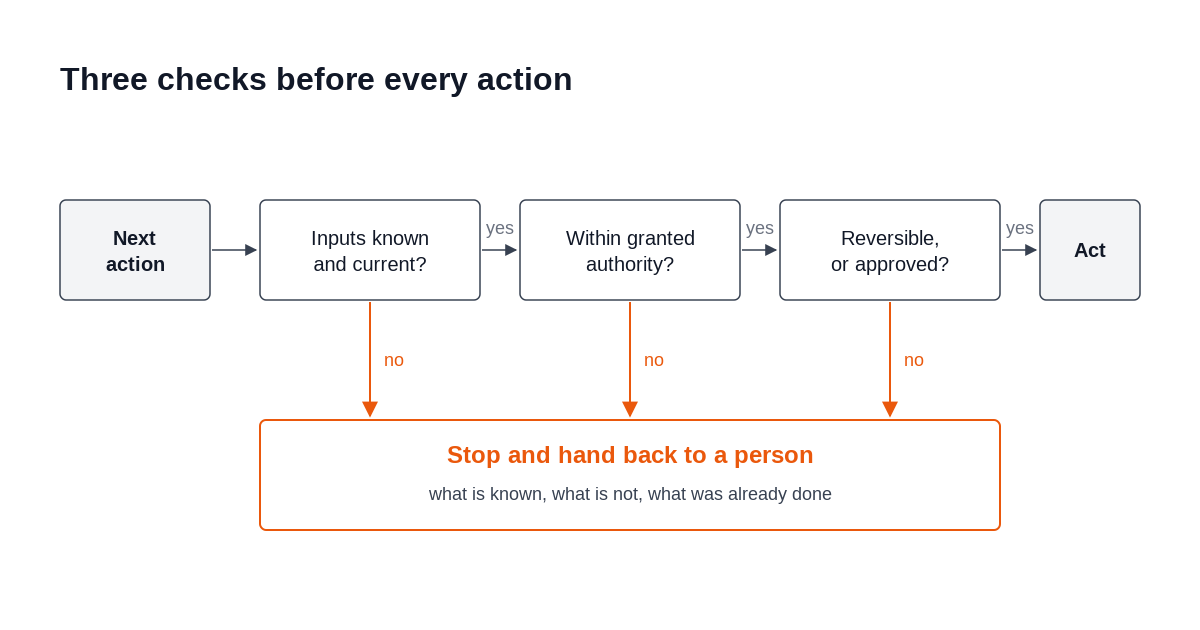
A workflow should stop and hand back control when its next action would rest on something it does not know, go beyond the authority it was given, or be impossible to undo. Those three conditions cover most of the cases that matter, and each can be checked before an action rather than discovered after it.
The usual way of thinking about this treats stopping as a failure: the automation broke, a person had to step in. That framing produces systems tuned to avoid stopping, which is the wrong objective. A workflow that never hands back control is either doing very little or doing things it should not. The useful question is not how to stop less, but how to stop at the right moments and leave the person who takes over with less work, not more.
The first condition: the workflow does not know
The clearest reason to stop is missing or unreliable information. An agent asks another agent for a stock level and receives an error. A lookup returns two customer records that might be the same customer. A sensor reading is outside any plausible range. A record's version has changed since it was read, and a fresh read now contradicts the plan.
A workflow that never hands back control is either doing very little or doing things it should not.
In each of these, the workflow could continue by assuming. It could treat the error as zero, pick the more recent record, discard the outlier, or proceed on the old read. Sometimes an assumption is safe and written into policy: a documented default, applied the same way every time and recorded as such. More often the assumption is invented at the moment it is needed, and the workflow has quietly replaced a fact with a guess.
The test is whether the action would still be correct if the assumption were wrong. If a mistaken stock figure would only delay a low-priority report, continuing with the unknown marked is reasonable. If it would schedule a technician for a repair that cannot start, or order a part that is already on the shelf, the workflow should stop. The publication's benchmark for governed AI workflows includes a case of exactly this kind, in which an inventory agent is unavailable and the expected outcome is an escalation with stock preserved as unknown and no work order submitted.
Knowing the facts is necessary but not sufficient. A workflow can know everything relevant and still be the wrong party to act.
The second condition: the action is not the workflow's to take
Every autonomous workflow operates under limits, whether they are written down or not. A procurement workflow may approve purchases up to a value threshold. A maintenance workflow may draft work orders but not submit them without a supervisor. A finance workflow may match invoices but not release payments to a new supplier. These limits are the workflow's authority, and they should be explicit, enforced outside the model, and visible in the trace.
The model should not be the component that decides whether an action is within authority. A policy check that sits between the decision and the system of record, and that refuses actions outside the granted limits, is more reliable than an instruction in a prompt. When the check refuses, the workflow has reached a stop condition, and the correct response is to route the case to someone who holds the authority, with the decision it would have made and the reasons.
Authority is not only about value thresholds. It includes scope (which systems, which records, which business units), novelty (a supplier, a part number, or a request type the workflow has not handled before), and conflict (two policies that point in different directions). A workflow that meets something genuinely new is at the edge of what it was designed and tested for, and handing back control is how it stays inside that edge. Even an action that is permitted, though, can still be the wrong one to take alone if there is no way back from it.
The third condition: the action cannot be undone
Some actions can be reversed cheaply. A draft can be deleted, a reservation released, a ticket reopened. Others can be compensated only partially or at a cost: a canceled purchase order after a supplier has accepted it, a payment that must be recalled. Some cannot be reversed at all. A message to a customer has been read. A shipment has left.
The more costly the reversal, the stronger the case for stopping before the action and asking for approval, even when the workflow knows the facts and holds the authority. This is the distinction between being on the loop and in the loop. Reversible work can proceed under supervision, with a person sampling results and able to undo them. Irreversible work warrants a person approving it first. Deciding which actions fall on which side is a design decision, made per action type, and it should be written down rather than left to the model at run time.
There is also a systemic version of this condition. When failures repeat, such as several workflows hitting the same unavailable service or the same rejected write, a circuit breaker should stop new attempts across the board. Continuing to act while a dependency is failing multiplies the number of cases that will need to be reversed later.
What a good hand-back contains
Stopping is half of the behavior. The other half is what the person receives. A bare error message, or a draft forwarded for approval with a gap in it, transfers the whole investigation to the person and discards the work the workflow had already done.
A useful hand-back reads like a short case file:
- what triggered the workflow, and the records it consulted;
- what it established, and from which system;
- what it could not establish, and why;
- which stop condition it reached;
- what it has already done, and whether any of it needs to be reversed;
- what it would do next, and what decision it needs from the person.
Stopping is half of the behavior.
The case should arrive in a queue that someone owns, with a clear way to resume the workflow once the decision is made, so that the person supplies the missing judgment and the workflow carries on, rather than the person finishing the job by hand. This is the difference between an escalation and an abandonment. Both stop the automation. Only one of them leaves the business in a known state.
Measured over time, stops are also information. A stop condition that fires often may point to a missing integration, a stale cache, or a policy limit set too low. One that never fires may mean the check is not wired to anything. Reviewing where and why workflows hand back control is how their authority can be widened on evidence, one action type at a time.
New research, benchmark results and reporting, by email.
No more than one email a week. Unsubscribe from any email. See the privacy notice.