What Changes When Agents Run Inside an Air Gap?
Inside an air gap everything an agent depends on from outside, from model weights and packages to identity, licenses and telemetry, has to cross the boundary by hand or be rebuilt inside it, and that cost belongs in the design from the start.
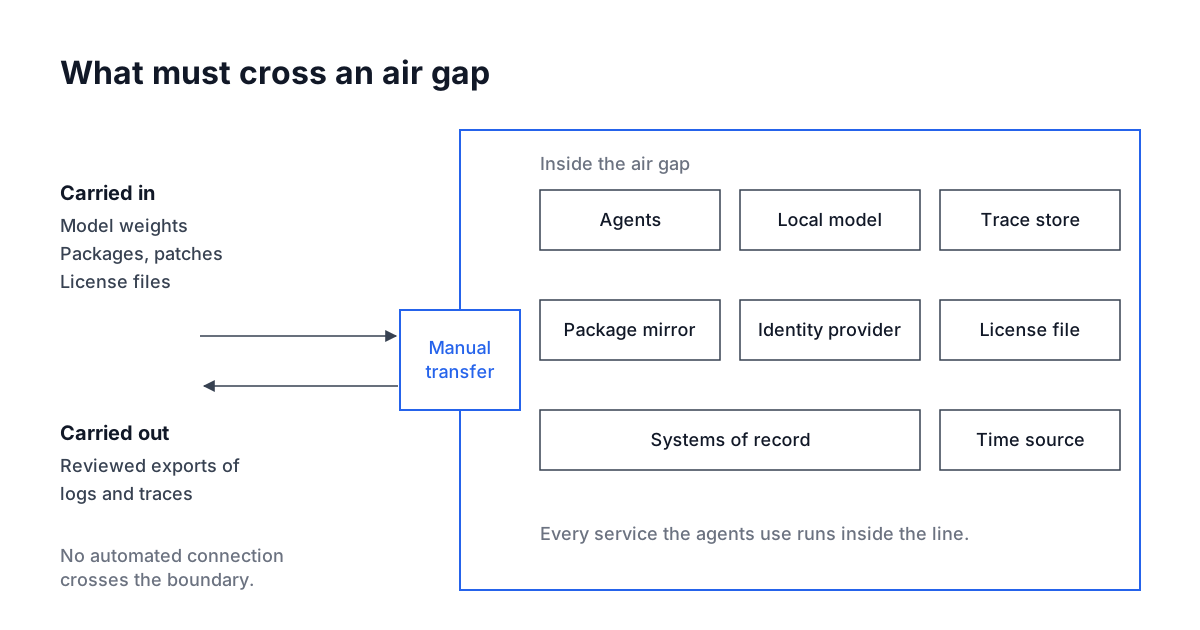
When agents run inside an air gap, everything they would normally fetch from outside the network has to be brought in by hand or rebuilt inside, and every signal they would normally send out has to stay in. Model weights, software packages, identity, licenses and telemetry all change. None of these is exotic. Together they make an air-gapped agent deployment a different operating commitment from a connected one, and the difference is easiest to manage when it is designed for rather than discovered.
That depends on being precise about what an air gap is, because the term is often used for things that are not.
What an air gap is
The definition used by the US national security systems community, as recorded in the NIST glossary from CNSSI 4009-2022, describes an air gap as an interface between two systems at which they are not connected physically and any logical connection is not automated: data crosses only manually, under human control.
Several common arrangements do not meet that definition. A private cloud network with no route to the internet still has automated connections to the provider's control plane. An enclave behind a firewall that allows outbound traffic to a short list of hosts has automated connections to those hosts. A segmented plant network reachable through a jump server has an automated connection through the jump server. Each may be a sound design. None is an air gap, and the difference matters because each automated connection is a path that software, including agents, can use without a person deciding. An air gap is not a firewall rule; it is the absence of any connection that software can use without a person deciding.
The publication's Governed AI Workflows benchmark applies the same strictness. A result may report air-gapped execution only when the runner records the network setup and provides evidence that the run occurred without public internet connectivity. A claim without that evidence is a description of intent.
An air gap is not a firewall rule; it is the absence of any connection that software can use without a person deciding.
With the boundary defined, the question becomes what has to cross it.
What has to cross inward
Model weights. A connected agent usually calls a model hosted by a provider. Inside an air gap, the model has to run locally, on hardware inside the boundary, from weight files carried in. That narrows the choice to models whose licenses permit local hosting and whose size fits the hardware available. Updates arrive the same way. A new model version is a file transfer, a security review and a re-test of every workflow that uses it, so the enclave runs a given version for longer than a connected deployment would.
Packages and images. Agent software depends on language packages, container images and operating system patches, each normally pulled from a public registry at build or deploy time. Inside the boundary these come from internal mirrors that someone fills by hand. Every dependency the agent platform needs, and every dependency of those dependencies, has to be in the mirror before installation, or installation fails. The mirror is now a supply chain with its own review step, its own lag behind upstream, and its own record of what was admitted.
Licenses. Commercial software often checks its license against a vendor server. Inside an air gap that check cannot happen, so the software has to accept an offline license file, and someone has to carry a new one in before the old one expires. A license expiry inside an air gap is an outage with a known date.
Identity. Agents need identities, and connected deployments often take them from a cloud identity provider. Inside the boundary the identity provider has to be local: a directory and a token service the enclave runs itself. Standards that assume a reachable network need attention. The Model Context Protocol's authorization specification, for example, relies on clients discovering an authorization server through published metadata documents over HTTP. Inside an air gap those documents, and every URL they reference, have to resolve to hosts inside the boundary. The same applies to certificate authorities and revocation lists, which agents check when they open a connection.
A license expiry inside an air gap is an outage with a known date.
Each inward item has a person responsible for carrying it, which raises the matching question about what goes out.
What stays in, and what goes out by hand
Telemetry. Most software, including agent platforms and model runtimes, sends usage data, error reports or update checks to its vendor by default. Inside an air gap each of these either fails silently, fails loudly or retries indefinitely. All of them have to be identified and turned off, and the platform has to keep working when they are. The vendor loses visibility it normally relies on to support the product, so support becomes a process of exporting reviewed diagnostics by hand.
Traces and logs. The trace of what each agent read, decided and did has to be stored inside the boundary, close to the systems of record it describes, because that is where an auditor will reconcile it. When logs or traces must leave, for a central security operations team or a regulator, they leave as reviewed exports through the same manual transfer point as everything else.
Time. An agent deciding whether a work order is overdue, or whether a token has expired, needs an accurate clock. Inside an air gap that clock comes from an internal time source rather than a public one.
What it changes for the design
Most of this work is familiar to anyone who has run software in a classified or safety-critical environment. What agents add is the number of external dependencies a typical agent stack assumes: a hosted model, a public package registry, a cloud identity provider, a vendor telemetry endpoint, and tool connectors that may themselves call out. Each assumption is reasonable on a connected network and each fails inside an air gap.
The practical consequence is that an air-gapped deployment should start from an inventory of every outbound connection the agent stack would make, rather than from the agents. Each connection is then removed, replaced with a local service, or converted into a manual transfer with an owner and a schedule. The result is slower to change than a connected deployment and easier to reason about: everything the agents can reach is inside a boundary that someone can draw and defend. Where the agent tier sits in the wider stack is covered in How Agents Fit Into the Enterprise Stack; inside an air gap, that tier and every layer it depends on sit on the same side of one line.
New research, benchmark results and reporting, by email.
No more than one email a week. Unsubscribe from any email. See the privacy notice.