What Changes When AI Owns the Next Step?
When software rather than a person holds the next step in a process, the person's work shifts from moving each case forward to deciding where the software must stop.
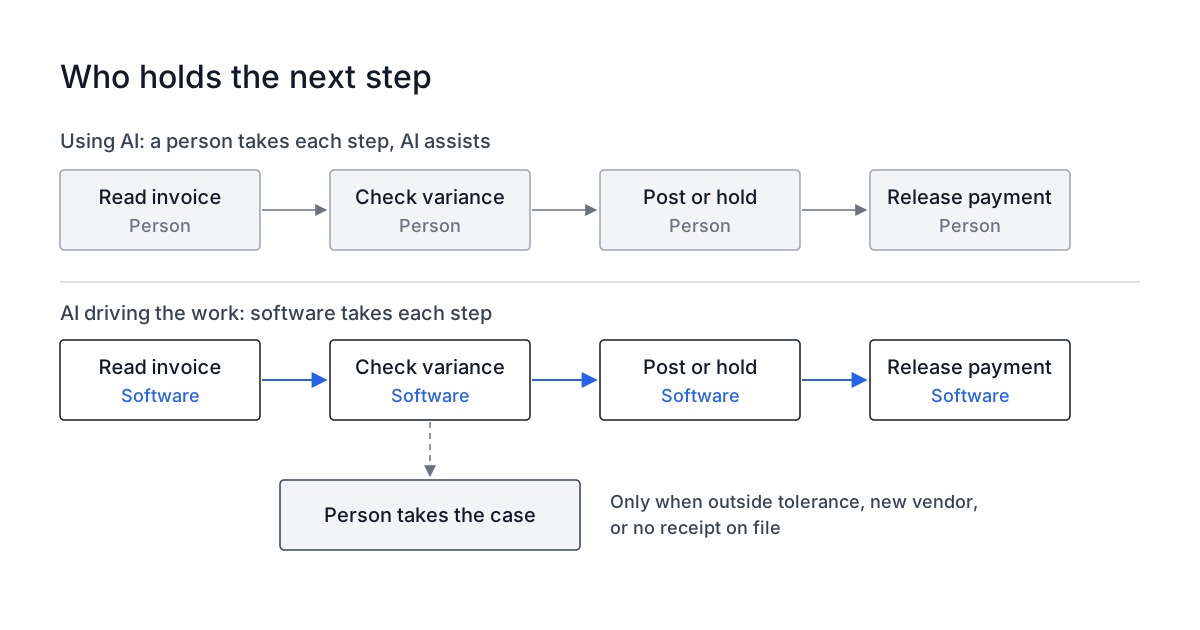
When AI owns the next step in a process, the person who used to take that step stops moving work forward and starts setting the conditions under which work is allowed to move. Most of what matters about autonomous operations follows from that one change: what a queue means, who answers for a stalled case, and what has to be written down before anything runs.
Most enterprise AI today does not hold the next step. Consider an accounts payable clerk working an invoice that failed a three-way match. An assistant can summarize the vendor's email, compare the purchase order with the goods receipt, and draft a note to the buyer. Then it stops. The clerk reads the draft, decides whether the variance is acceptable, posts the adjustment or places the hold, and moves on. The assistant made the step faster. It did not take it, and the invoice waits until a person picks it up.
That sounds like a difference of degree. It is a difference in who the queue belongs to.
Who holds the pen
At any moment in a process, one party holds the next step. With assistive AI that party is always a person, and the software is consulted. In what this publication calls an autonomous workflow, the software holds the next step by default, and a person holds it only when the software hands it over or when policy requires a person's decision.
Take the same invoice. The software reads the purchase order, the receipt and the invoice from the ERP. It finds a price variance and checks it against the tolerance the controller set. Inside tolerance, it posts the adjustment, writes the reason into the invoice record and releases the invoice for payment. Outside tolerance, or with a new vendor, or with no receipt on file, it places the hold itself and routes the case to a person with what it found and what it could not determine.
None of those actions is new. Matching, posting and holding were all done before. What changed is the default: the invoice moves unless something stops it, rather than waiting until someone moves it.
That reversal is small to describe and large in its consequences, because every arrangement built around the old default now has to be rebuilt.
The invoice moves unless something stops it, rather than waiting until someone moves it.
What the default changes
The first thing to change is the queue. It stops being a to-do list and becomes an exception list. The cases a person sees are the ones the software could not settle within policy. A clerk who used to open every invoice now opens the ones that need judgment, and the rest are visible as finished work with a record attached.
The second is accountability. When a person moved every case, a stalled invoice had an owner by construction: whoever had it. When software moves most cases, someone still has to answer for invoices settled correctly and on time, including the ones no person touched. The site's glossary calls this outcome ownership. Without a named owner, the cases the software handles well belong to nobody, and so do the ones it handles badly.
The third is where the rules live. The tolerance, the vendor checks, the amount above which a person must approve: these used to sit partly in a policy document and partly in the clerk's experience. Once software owns the next step, they have to be written precisely enough for software to obey and for an auditor to check. When software owns the next step, writing the boundary down becomes the work.
A written boundary raises a prior question: why hand the step to software at all, when assistance already makes each step faster?
When software owns the next step, writing the boundary down becomes the work.
Why faster steps are not enough
The answer starts with what assistance has and has not delivered. MIT's NANDA initiative reported in August 2025 that 95 percent of the organizations it studied were getting no measurable return from generative AI (Fortune, August 2025). The report does not reduce that result to a single cause, and this post does not claim one. The figure is consistent with a plain observation about assistive use: if a person still takes every step, the cost of the process is still set by the number of steps people take. A faster draft saves minutes inside a step. It does not remove the step, the handoff to the next one, or the hours a case spends waiting in someone's queue.
Owning the next step is what removes the wait. It is also what introduces the risk, because a step taken by software can be wrong without anyone having looked at it first. That risk is acceptable only when the system can show, case by case, that it stayed inside its boundary.
What has to hold before the default flips
Three properties carry most of the weight. The software stops when it is told to stop: an approval that policy requires is waited for, and a denial ends the action rather than delaying it. The software escalates a case it cannot finish instead of guessing, and the escalation says what is known and what is not. And every case leaves a trace of what was read, decided and written that reconciles with the systems of record it touched.
These are testable properties, not intentions. The Governed AI Workflows benchmark checks them on a single maintenance workflow: whether a work order is submitted only after a supervisor approves the draft, whether a denial leaves no submission behind, and whether a failed handoff between agents is escalated with stock recorded as unknown rather than assumed. A system that passes on one workflow has not earned the default everywhere. It has shown that the boundary held where it was tested, which is the only kind of evidence an operations leader can act on.
What the evidence cannot settle is who keeps authority once the software is moving most of the cases.
Moving the next step to software does not move authority. The controller still sets the tolerance. The buyer still owns the vendor relationship. The person who approves a large adjustment still approves it, and the record now shows exactly what was approved and when. People supervise from on the loop rather than working each case from inside it.
The clerk's role changes accordingly. The clerk's hours go to the invoices that need judgment and to the rules that decide which invoices those are. When the same kind of exception keeps arriving, the useful response is to change the tolerance or the vendor check, with the controller's agreement, so that the next hundred cases resolve without a person.
That is the practical question for any operations leader weighing this shift. It is not whether a model is accurate enough in general. It is which step in which process has a boundary that can be written down, tested and audited now, and who will own the outcome once the software holds the pen.
New research, benchmark results and reporting, by email.
No more than one email a week. Unsubscribe from any email. See the privacy notice.