What Makes Human Approval Meaningful?
Human approval means something only when the action cannot proceed without it and the person approving has the evidence, time and authority to refuse.
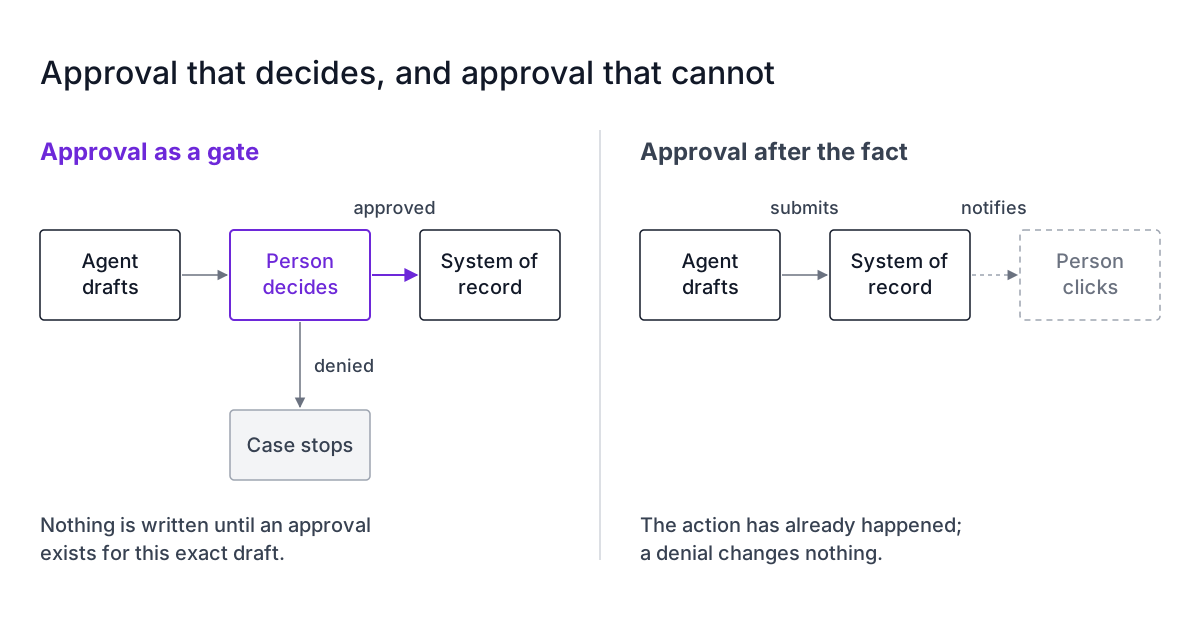
An approval is meaningful when two things are true: the action cannot happen without it, and the person giving it could realistically have said no. Many approval steps in agentic systems are built to satisfy the first condition and quietly fail the second. Some fail both, and look exactly like the ones that pass.
The first test is mechanical
Consider a hypothetical procurement agent that drafts purchase orders and routes each one to a buyer. The buyer sees a card in a queue, clicks approve, and the order is released to the supplier. That looks like a gate. Whether it is one depends on a detail the buyer never sees: what happens if the agent calls the ordering system before the approval arrives.
If the ordering system accepts the call, the approval is advisory. It records a person's opinion about an action the agent was able to take anyway. The approval step lives inside the agent's workflow, and the agent's workflow is the thing being supervised. A model that misreads where it is in the process, a retry after a timeout, or a change to the orchestration logic can each produce a submission with no approval behind it.
The mechanical test is whether something outside the agent refuses the action until an approval exists for that specific item. The approval should reference the exact draft, so that approving one order cannot release a different or edited one. A denial should end the case rather than send the agent looking for another route. This is what the Governed AI Workflows benchmark measures. A work order may be submitted only after an explicit approval for that draft, and any submission attempt before approval or after denial is a policy failure, even if no work order is created.
Passing that test shows the approval is causal. It does not show that anyone made a decision.
The second test is human
An approval step that a person cannot meaningfully refuse becomes a rubber stamp, and rubber stamps are produced by design, not by careless people. Four conditions tend to produce them.
The approver lacks information. They see the agent's summary and a button, not the records the agent read. To refuse, they would have to rebuild the case from the systems of record themselves, which takes longer than the step allows.
The approver lacks time. If a queue holds several hundred items and the approver has an afternoon, the arithmetic decides most of them before the person does.
An approval step that a person cannot meaningfully refuse becomes a rubber stamp, and rubber stamps are produced by design, not by careless people.
The approver lacks authority. They can approve but cannot change the terms, and a denial creates work for them and for no one else. When refusing costs more than agreeing, agreement becomes the default.
The approver has learned to trust the system. After weeks in which every recommendation was right, the reason to look closely fades. The EU AI Act names this tendency. For high-risk AI systems, Article 14(4) requires that the system be provided so that the people assigned to oversee it are enabled "to remain aware of the possible tendency of automatically relying or over-relying on the output produced by a high-risk AI system (automation bias)," and "to decide, in any particular situation, not to use the high-risk AI system or to otherwise disregard, override or reverse the output" (Regulation (EU) 2024/1689, Article 14). The Act places these requirements on how a high-risk system is built and provided. It does not prescribe how an approval queue should look, and it does not reach systems outside its high-risk categories.
Each of the four conditions is a design choice, which means each can be designed differently.
Designing for refusal
None of the remedies involves asking people to try harder.
Show the evidence, not only the conclusion. The approval screen should carry what the agent read and from which system of record, what it proposes to write, which policy it applied, and what it was unsure of. An approver who can see that a vendor's bank details changed last week can refuse in seconds.
Ask for fewer approvals. Attention is the scarce input, and spending it on every routine case guarantees it will be thin on the cases that matter. Actions inside a written limit can run with a person on the loop, who samples, watches and can reverse; approval is reserved for actions above the limit, outside policy, or hard to undo. The glossary's distinction between human in the loop and human on the loop is the choice being made here.
Make denial cheap. A denial should take one action, carry a reason, and send the case somewhere defined, such as back to the agent with the reason or to a named person for manual handling. If denying means writing an email and opening a ticket, the system is asking for approvals and will receive them.
Give the approver the authority the step implies. Article 26(2) of the same Act requires deployers of high-risk systems to assign human oversight to people "who have the necessary competence, training and authority, as well as the necessary support." Outside the Act's scope the operational logic holds: an approver who cannot change the outcome is a witness, and a delegation of authority matrix should show that the approver holds authority at the amount being approved.
Designing for refusal is necessary but does not prove that refusal happens. That takes measurement.
Measuring whether approval is doing anything
A team can check both tests with data it already holds. For the mechanical test, compare the system of record's log against the approval log: every submission should carry a reference to an approval for that exact item, and no submission should follow a denial. The expected count of exceptions is zero, and the comparison should run continuously, not only at audit time.
For the human test the signals are indirect but readable. The denial rate shows whether refusal ever happens. Time to approve, set against the size or risk of the item, shows whether larger items receive more attention. The share of approvals given within seconds of an item reaching the queue shows how many were read. None of these has a correct value. A denial rate near zero can mean the agent is accurate, or it can mean nobody is looking.
The way to tell the two apart is the one internal audit already uses for other controls: test it. Place a known-bad item in the queue from time to time, an invoice with a mismatched receipt or an order above the approver's limit, and record whether it is caught. An approval step that catches the seeded errors is doing work. One that does not has become a record that someone clicked, which is useful evidence of something, but not of a decision. Both kinds of record belong in the case trace described in How to Audit an Autonomous AI Worker.
New research, benchmark results and reporting, by email.
No more than one email a week. Unsubscribe from any email. See the privacy notice.