What Should You Never Ask a Model to Decide?
Never ask a model to decide anything whose answer already exists in a record, a rule or a calculation, or anything about its own authority to act.
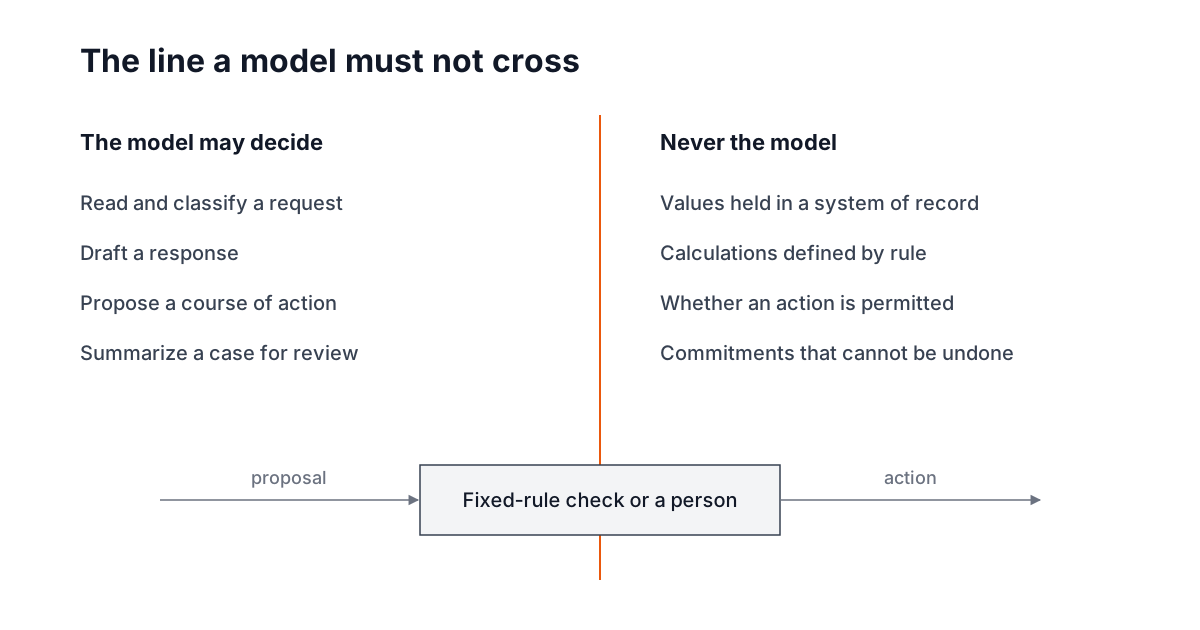
There are two kinds of decision a model should never make in an enterprise workflow: decisions whose answer already exists somewhere the system could look it up, and decisions about the model's own authority to act.
The first kind is a matter of accuracy. The second is a matter of control. Both are easy to hand to a model without noticing, because a model will answer either fluently, and in a demonstration the answer will usually be right. The case for keeping them out of the model rests on what happens in the cases where it is not.
Answers that already exist
Some questions in a workflow have an answer stored or defined before anyone asks. A customer's credit limit is a field in the ERP. The exchange rate used for month-end close is the rate the treasury team loaded for the period. The VAT on an invoice line is a calculation defined by the rate table and the rules for the jurisdiction. The approver for a purchase over a given amount is a row in the delegation-of-authority matrix. The current owner of an asset is a field in the maintenance system.
A model asked any of these questions will generate an answer. It may have seen the figure earlier in the conversation, or have something close to it in its context, or produce something that looks like the right kind of number. None of that is the same as reading the field. The system of record is authoritative by definition; a model's version of its contents is at best a copy and at worst an invention, and in either case it can drift from the source without anyone noticing.
The rule that follows is simple to state. If the answer can be looked up or calculated, look it up or calculate it, in code, and give the result to the model as an input rather than asking the model to produce it. The model can then do what it is good at: explaining the figure, comparing it with something in a document, deciding what to write to the customer. It never becomes the source of the figure.
If the answer can be looked up or calculated, look it up or calculate it, and give the result to the model as an input.
This removes a large class of error. It does not touch the second kind of decision, which is harder to see because it does not look like a decision at all.
Decisions about its own authority
A model inside a workflow is constantly, implicitly, deciding whether it is allowed to do the next thing. Whether this refund is within the amount it may approve. Whether the employee asking for access to the payroll system is entitled to it. Whether this vendor bank-detail change needs a second approver. Whether the work order can be submitted now or must wait for the supervisor.
Each of these can be written into a prompt as an instruction, and a well-built model will mostly follow it. The difficulty is that the instruction and the case arrive through the same channel. The model reads the policy, then reads an email that says the manager has already approved this verbally, or a ticket that says the request is urgent and the usual check has been waived, or a document that contains text written to look like a new instruction. Whether the model holds the line is then a property of the model's behavior on that input, not of the system.
Authority has to be enforced where the model cannot reach it. That means the model's credentials do not permit the action at all, or the action runs through a fixed-rule step that checks a condition the model did not set: an amount against a threshold held in configuration, an approval record that references this exact item, a role in the identity system. The model may propose. The check decides whether the proposal proceeds. In the publication's benchmark for governed AI workflows, any attempt to submit a work order before approval counts as a policy failure even when another component blocks it, because the attempt itself shows that the boundary was being decided in the wrong place.
The model may propose. The check decides whether the proposal proceeds.
Those two categories cover most of the line. A third sits at its edge and needs separate treatment.
Commitments that cannot be undone
Some actions cannot be cheaply reversed once taken: releasing a payment, sending a denial letter on a claim, terminating a contract, revoking a departing employee's access, filing a return. Even when the model has read the case well and the authority checks pass, the act of commitment should belong to a fixed rule that the business has approved in advance or to a named person.
This is not a claim that models judge these cases badly. A model may assemble the evidence for a claim denial more thoroughly than a rushed adjuster. The point is accountability. An irreversible decision affects someone outside the process, and the organization has to be able to say who made it and on what basis. A fixed rule has an owner who approved it. A person has a name. A model's choice, on its own, has neither. Keeping the commitment outside the model is what lets the rest of the work, the reading, the assembly, the drafting, be handed to it.
What is left for the model
Drawing the line this way can sound like it leaves the model very little. In practice it leaves the part of most workflows that has always consumed the most human time. Reading a request written in someone's own words and working out what they need. Classifying a claim from a description and photographs. Matching an invoice line to a purchase order line when the descriptions differ. Writing a summary of a case so that the person who must decide can do it in a minute. Proposing a course of action, with the evidence attached, for a fixed rule or a person to accept.
Those are decisions too, and real ones. They are the decisions where no answer exists in advance and where the result can be checked before it takes effect. That is the territory where an agent adds something no rule can, and where its mistakes, when they happen, are caught by the steps around it rather than discovered by a customer, an auditor or a bank. Whether a given workflow honors this line is something that can be read directly from its trace: every value the model used should point back to a lookup, every action it proposed should point forward to the check that let it through.
New research, benchmark results and reporting, by email.
No more than one email a week. Unsubscribe from any email. See the privacy notice.