How Much Human Intervention Does an Agent Still Need?
Count interventions by kind: approvals that policy requires are part of the design, while corrections, takeovers and reversals measure what the agent still cannot do.
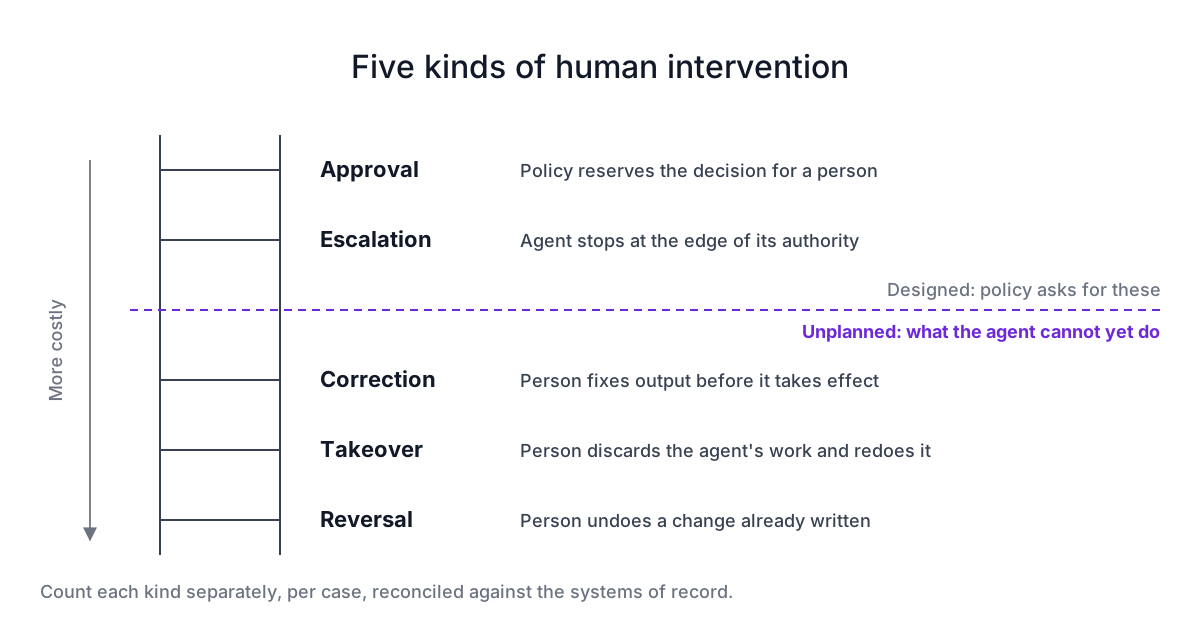
The useful measure of human intervention is not how often a person touched a workflow but how often a person had to touch it when policy did not ask them to. A single intervention rate mixes the two, and the mixture can make a well-governed agent look worse than a careless one.
Consider two hypothetical IT service desks automating requests for access to finance systems. The first requires a manager's approval for every request that grants write access, so its agent pauses on a large share of cases and its intervention rate looks high. The second removed that approval to make the numbers look better. Its rate is low, and a few times a month a security analyst revokes access that should never have been granted. By the single rate, the second desk is more autonomous. By any measure an auditor would accept, it is less controlled, and the analyst's work does not appear in its intervention count at all.
The difference is that the two desks are counting different things under one name. Separating them starts with naming the kinds.
Five kinds of intervention
Ordered from the least costly to the most, the interventions a person makes in an agent's workflow fall into five kinds:
- Approval. Policy requires a person to decide before an action takes effect: a payment above a threshold, a work order on safety-critical equipment, write access to a ledger. The agent prepares the decision; the person makes it.
- Escalation. The agent stops and hands the case over because it cannot proceed within policy: a system is down, data conflicts, the request is above its authority. A good escalation says what is known and what is not.
- Correction. A person edits the agent's output before it takes effect: changes the quantity on a reorder, fixes the cost center on a journal entry, rewrites the reply to a claimant.
- Takeover. A person abandons the agent's work on a case and does it by hand.
- Reversal. A person undoes an action after it has reached a system of record: voids a payment, cancels a purchase order, restores a closed ticket.
The first two are designed. Policy asks for an approval; a warranted escalation is the agent doing what it was told to do when it reaches the edge of what it may decide. This is the human on the loop working as intended, and a lower count is not automatically better. The last three are unplanned. Each one is work a person did because the agent got something wrong, and each one is more expensive than the one before it, because a correction catches the error before it takes effect, a takeover discards the agent's work, and a reversal has to unwind consequences that other systems may already have acted on.
An approval is a decision a person was supposed to make; a correction is a decision the agent was supposed to make and did not. Treating them as the same event is the root of most confusion about how autonomous a system is.
An approval is a decision a person was supposed to make; a correction is a decision the agent was supposed to make and did not.
The intervention that does not get counted
Typed counts solve the mixing problem, but only for interventions that pass through the workflow. The more troublesome kind happens outside it. A planner notices a reorder quantity is wrong and fixes it directly in the ERP. A controller adjusts an accrual during month-end close without touching the agent's case. The agent's records show a clean run; the system of record shows a change the agent did not make.
These silent interventions are why intervention cannot be measured from the agent's own logs. It has to be measured by reconciling the agent's trace against the systems it wrote to. Any state change on a case that the trace does not account for is an intervention, usually a correction or a reversal, made by someone who found it easier to work around the agent than through it. A rising rate of silent intervention is often the first sign that people have stopped trusting the agent, well before anyone says so.
Escalations need a similar check from the other side. An escalation that hands a person the case with nothing attached, so that they must repeat every lookup the agent made, is a takeover recorded under a more flattering name. Scoring an escalation by what it leaves the person to do keeps the category honest.
Choosing the denominator
Counts need a denominator, and the choice changes the answer. Interventions per case is the measure operations leaders recognize: of the claims the agent handled this month, how many needed a correction, how many were taken over, how many were reversed. Interventions per state-changing action is finer and better for diagnosis, because a case with twelve writes and one correction differs from a case with one write and one correction.
Whichever denominator is chosen, it has to be fixed before the measurement starts and reported with the result. The same goes for the boundaries of a case. If a reversal three weeks later is not attributed back to the case that caused it, the reversal rate will look low for exactly the reason it matters.
There is a practical reason to do this carefully. MIT Project NANDA reported in August 2025, in "The GenAI Divide: State of AI in Business 2025," that 95% of the organizations it studied were getting no measurable return from generative AI. Whatever the causes in those organizations, return cannot be measured on a workflow whose human cost is not measured, and the human cost of an agent is mostly the unplanned interventions around it.
What the trend should show
Once interventions are typed, attributed and reconciled, the trend over time becomes informative. Unplanned interventions should fall as the agent and its policies improve. Approvals should change only when someone decides to change the policy, never by drift. Escalations should track the real rate of system failures and ambiguous cases, not fall towards zero, because an agent that stops escalating has not become better at its job; it has become more willing to guess.
That gives the decision to remove an approval a basis. If corrections on a class of decision have stayed near zero for a sustained period, and reversals have not appeared, the approval can be narrowed or sampled instead of required. That is a governance decision made on evidence, recorded with its reasoning, and reversible if the counts move.
The floor beneath all of this is that the agent honours the interventions it is given. When a person denies an approval, nothing should happen; when a system fails, the agent should escalate rather than proceed. The publication's Governed AI Workflows benchmark tests exactly that floor with a denied approval and a failed handoff between agents. An agent that cannot pass it has no intervention rate worth reporting, because the people around it cannot rely on their decisions taking effect.
New research, benchmark results and reporting, by email.
No more than one email a week. Unsubscribe from any email. See the privacy notice.