Which Steps Need Judgment and Which Need Fixed Rules?
A step needs judgment only when its correct answer cannot be written down before the case arrives; how much freedom that judgment gets depends on whether its result can be undone.
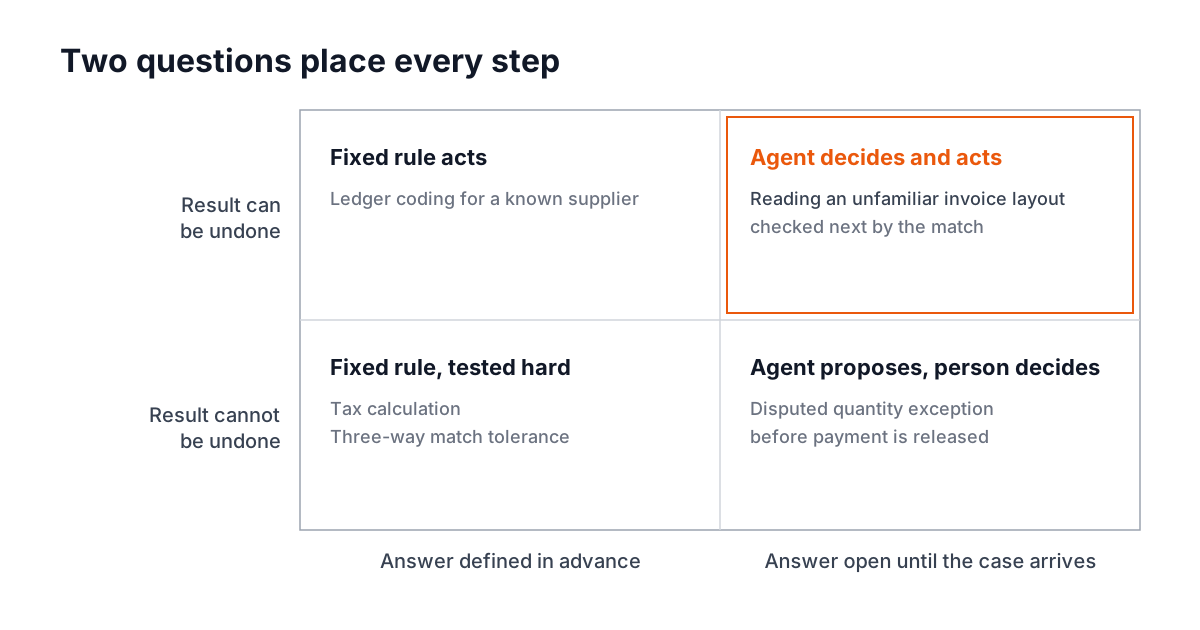
A step in an enterprise workflow needs judgment only when its correct answer cannot be written down before the case arrives. Everything else should run on a fixed rule, however hard the step looks.
That test is narrower than the one most teams use. The usual question is whether a step is complex, and complexity is a poor guide. Calculating sales tax across jurisdictions is complex, but the right answer is defined in advance by the tax tables and the rules for applying them. Deciding whether a supplier's handwritten note on a delivery slip changes what was received is simple to describe and impossible to specify. The first belongs to a rule. The second belongs to judgment. The difficulty is a property of the work; whether the answer is defined in advance is a property of the decision, and only the second tells you what kind of component should make it.
Answering that question for each step still leaves a second one open. Two steps can both need judgment and still deserve very different treatment.
The first question: is the answer defined in advance
Take invoice processing, a workflow most finance teams know step by step. An invoice arrives. Someone or something reads it, extracts the supplier, amounts, lines and terms, matches it to a purchase order and a goods receipt, checks the difference against a tolerance, calculates tax, codes it to the ledger, and either releases it for payment or routes it as an exception.
Walk the steps and ask of each one whether a correct answer exists before the invoice does.
- Tax calculation: yes. The rate, the base and the jurisdiction rules exist in advance. A model that produces a tax figure is approximating a table that is already available.
- The three-way match tolerance: yes. The policy says what variance is acceptable. Applying it is arithmetic.
- Ledger coding for a known supplier and item: yes, in most cases. The mapping lives in the vendor master and the chart of accounts.
- Reading an invoice whose layout the system has never seen: no. There is a correct extraction, but no rule written before the invoice arrived could have produced it.
- Deciding what to do with an exception where the quantity received differs from the quantity billed and the supplier has attached an explanation: no. The answer depends on reading that explanation in context.
The steps that need judgment are the ones where the input varies in ways nobody could enumerate. Every other step has an answer that already exists somewhere in the business, in a table, a policy or a system of record, and the job of the workflow is to look it up and apply it, not to reconstruct it.
Every other step has an answer that already exists somewhere in the business, and the job of the workflow is to look it up and apply it, not to reconstruct it.
This sorting usually leaves far fewer judgment steps than the first design assumed. It does not yet say how much authority each one should have.
The second question: can the result be undone
Reading an unfamiliar invoice layout and resolving a disputed exception both need judgment. They do not carry the same risk. If the extraction is wrong, the next fixed-rule step, the three-way match, will usually catch it: the amounts will not reconcile and the invoice will stop. The mistake is caught inside the process and costs a few minutes. If the exception is resolved wrongly and the payment is released, money has left the account. Recovering it means a request to the supplier, a credit note, perhaps a dispute.
Reversibility, then, sets how far a judgment step may act on its own. It is worth being specific about what reversible means here. A result is reversible when it can be undone inside the process, by the system or by a person, before it has an effect outside the organization or on someone's rights. An extraction that feeds a match is reversible. A draft in a review queue is reversible. A payment, a credit decision communicated to a customer, a revoked access right on someone's last day, or a filed tax return is not, or not cheaply.
That gives four places a step can land, and each has a different design.
Four placements and what each one means
Defined answer, reversible result. Run a fixed rule and let it act. Ledger coding for a known supplier is here. There is nothing for a model to add.
Defined answer, irreversible result. Run a fixed rule and test it hard, because errors are systematic rather than occasional. Tax calculation and payment release under policy are here. A model can sit nearby, explaining a tax result to a person who asks, but it should not produce the figure.
Open answer, reversible result. Let the agent decide and act, inside a bounded step, with a fixed-rule check after it. Reading the unfamiliar invoice is here. This is where an agent, in the site's glossary sense of a component that uses a model to interpret a situation and choose an action, earns its place, and where most of the practical value of putting models into workflows is found.
Open answer, irreversible result. Let the agent read, assemble the case and propose, and have a person decide. The disputed exception is here. The agent does real work: it gathers the receipt, the purchase order, the supplier's note and the history of similar cases, and it writes a recommendation that a person can accept or reject in a minute rather than investigate for twenty. But the decision that moves money stays with someone who can be held to account for it.
Reversibility sets how far a judgment step may act on its own.
The same grid applies outside finance. In claims triage, reading the claimant's description and classifying the loss is open and reversible; setting the reserve under the insurer's reserving rules is defined; denying the claim is open and irreversible. In access provisioning, interpreting a free-text request for "the same access as my predecessor" is open and reversible, because the result is a proposed role set; checking that set against segregation-of-duties rules is defined; granting access to a payments system is a commitment that should wait for an approver.
Where teams put the line wrongly
The common error is not giving a model too much judgment. It is giving a model steps that were never judgment in the first place. A credit limit check, a tax figure, a tolerance comparison: each can be phrased as a question a model will answer fluently, and each answer will usually be right. Usually is the problem. A fixed rule is right every time the rule is right, and when it is wrong it is wrong the same way every time, which makes it findable. A model that approximates the rule is wrong occasionally and differently, which makes it hard to find.
The opposite error also occurs. Teams that have been burned by unpredictable output sometimes push genuinely open steps back into rules, writing longer and longer extraction templates or exception decision trees. The rule set grows, the cases it misses grow with it, and the misses land in a manual queue that nobody planned for. That is the familiar limit of RPA: reliable while the process is unchanged, brittle when the input varies.
The grid does not settle every placement. Some steps sit on a boundary: a coding decision for a new supplier, an extraction from a document type seen only twice. For those, the question to ask is which error you would rather find later, a systematic one or an occasional one, and whether the step after it can catch either. Placing each step on purpose, and recording why, is most of what it takes for a workflow to be explained to an auditor, and what follows from those placements, how a bounded agent step is built and checked, is a design question in its own right.
New research, benchmark results and reporting, by email.
No more than one email a week. Unsubscribe from any email. See the privacy notice.