Why Some Workflows Should Stay Automated
Where every branch of a workflow can be written down in advance, autonomy adds supervision and cost without adding anything a script does not already do.
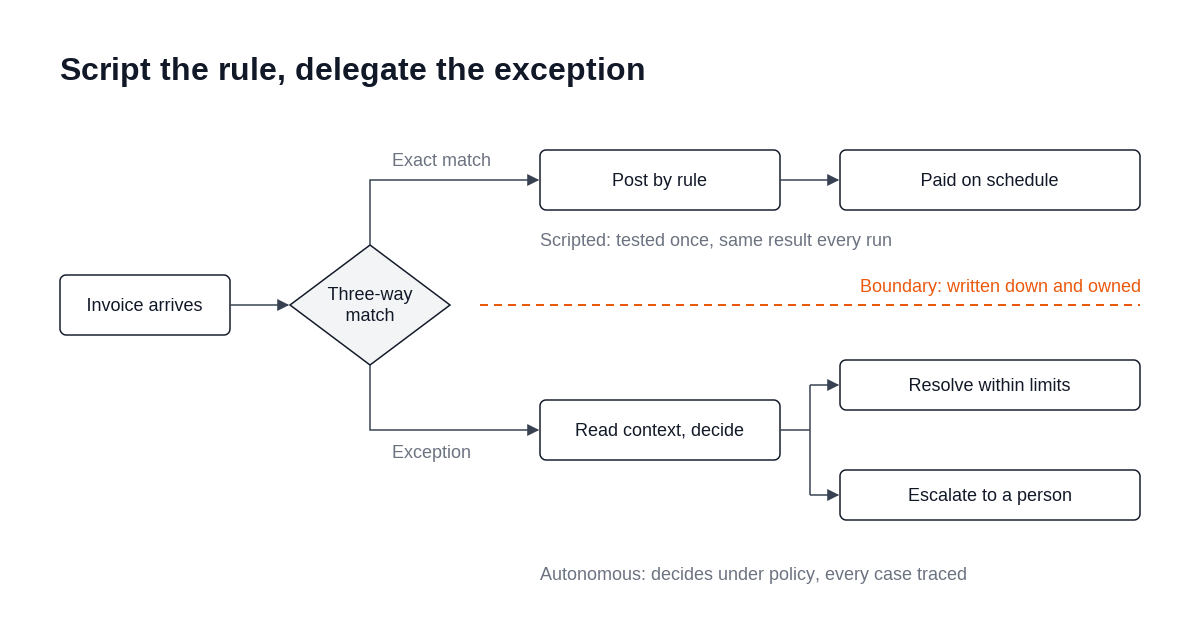
A workflow should stay automated when every branch in it can be written down in advance, because what autonomy adds is judgment, and judgment has to be supervised. A script that moves a payroll file to the bank at the same hour every night has no decisions in it. Giving that step to a system that reads, reasons and chooses does not make it better. It makes it different on some nights, and the organization then has to build controls to find out which nights.
That is not an argument against autonomy. It is an argument about where autonomy earns its cost, which depends on knowing what the cost is.
What autonomy costs
Every decision a system makes on its own carries obligations a script does not. There has to be a policy that bounds the decision. There has to be a trace that records what the system read and why it chose as it did. Someone has to sample its work and judge whether it was right. When the underlying model changes, someone has to check that the decisions have not drifted. And there has to be a path for the cases the system should not decide, with a person at the end of it.
A script needs almost none of this. Its behavior is its code. Once tested, it does the same thing on the ten-thousandth run as on the first, and when it fails it usually fails loudly, with an error rather than a plausible wrong answer. That property is easy to undervalue because it is so ordinary. It is also what auditors rely on when they test a control once and accept it for the year.
Putting a model into a step that has no decision in it trades that property away. The organization replaces a deterministic step with a probabilistic one, then spends effort on evaluation and monitoring to make the new step nearly as dependable as the old one was without any.
The trade can be worth making when the step really does involve judgment. The difficulty is recognising, in advance, which steps do.
The organization replaces a deterministic step with a probabilistic one, then spends effort on evaluation and monitoring to make the new step nearly as dependable as the old one was without any.
Signs a workflow belongs to a script
Some workflows show their nature plainly. A workflow is a good candidate to stay automated when most of the following hold:
- Its inputs are structured and arrive from a single system in a known format.
- Every branch can be listed, and the list changes rarely and on purpose.
- The right action can be determined from the record alone, without reading a contract, an email or a note.
- Identical cases are expected to be treated identically, by policy or by regulation.
- Volume is high and the cases closely resemble one another.
Interest accrual at month-end close fits this description. So does a reorder for shop-floor consumables at a fixed reorder point, a nightly reconciliation of bank lines that match ledger entries exactly, and a password reset for a user who has already passed identity verification. In each, the hard part was designing the rule. Running it requires no further judgment, and an auditor would rather see a rule than a reason.
The list describes steps, though, not whole processes. Very few end-to-end processes in an enterprise satisfy it from trigger to result, which raises the more useful question of where inside a process the judgment begins.
The exception is where the boundary sits
Most processes are mixed, and the mix has a shape. Consider accounts payable. Invoices that match the purchase order and goods receipt exactly can be posted by rule, and in many organizations a large share of them already are. The remainder are exceptions: a short shipment, a price that differs from the contract, a receipt that was never recorded. Resolving those means reading the contract, the supplier's correspondence and the receiving notes, then deciding whether to pay, hold or query. That is context, decision and action, the first three of the four properties that distinguish autonomy from automation.
IT service desks have the same shape. A password reset is a rule. A ticket that says the VPN stopped working after a laptop replacement is a diagnosis, and the right next step depends on what the device logs, the identity system and the asset record say.
The design that follows is a split. The script keeps the rule-shaped path and its volume. The autonomous system takes the exceptions and their variety, under a written limit on what it may do and with a path to a person for what falls outside it. Supervision then concentrates where decisions occur instead of being spread across thousands of postings that contained none. The boundary between the two paths becomes a design object in its own right, written down, owned by someone, and visible in the trace of every case that crosses it.
That leaves one problem. A boundary drawn correctly today will not stay correct, because the process on either side of it keeps changing.
Keeping the boundary in the right place
The boundary moves in both directions, and each direction has a signal.
When a supplier changes its invoice format or an ERP release changes a field, the script starts sending more cases down the exception path. A rising exception rate is the first sign that the rule-shaped part of the process is shrinking. The response is a choice to make deliberately: repair the rules, or accept that more of the work now needs judgment and staff the autonomous path and its supervision accordingly. Letting the exception queue grow without making that choice is how organizations end up with an autonomous system doing a script's job at a script's volume, with none of a script's predictability.
The opposite movement matters as much. When the autonomous system makes the same decision for a class of cases every time, with the same evidence and no escalations, that class has become rule-shaped. Writing it into the script moves it back to a step that can be tested once and relied on. This is not a retreat from autonomy. It is the system's judgment being converted into the organization's policy, which is the result a well-run exception process should produce.
A team that watches the boundary in both directions can say, at any month-end, which of its work runs on rules and which on judgment, and why each case went the way it did. That account is also what the Governed AI Workflows benchmark asks a system to produce for every run: the actions taken, the approval that allowed them, and the evidence to reconcile one against the other.
New research, benchmark results and reporting, by email.
No more than one email a week. Unsubscribe from any email. See the privacy notice.